
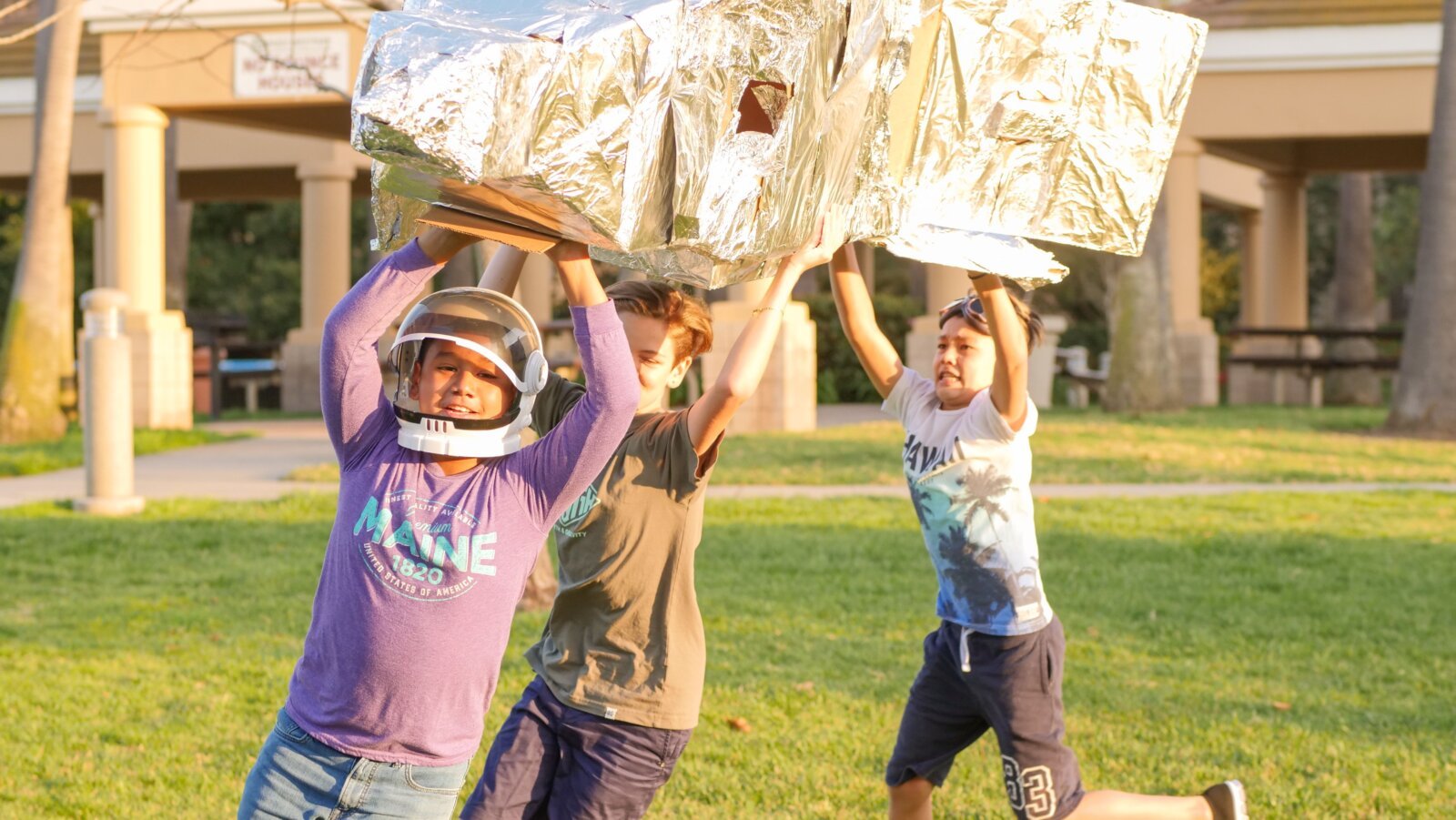
Your Kid Isn’t Just Playing Around. (Actually, They Are. That’s the Point.)
The science on why play isn’t a break from learning — it is the learning.
At some point, someone decided that the serious business of education and the frivolous business of play were two different things. Instruction happened at desks. Play happened at recess. And recess, if we’re being honest, was the thing that got cut first when the schedule got tight.
That decision made a certain kind of intuitive sense. It also turned out to be wrong.
Not a little wrong. Significantly, measurably, neurologically wrong. And the research to prove it has been piling up for decades while a lot of school schedules stayed exactly the same.
What’s Actually Happening in a Playing Brain
Here is something that sounds like it should be obvious but apparently needed a lot of peer-reviewed confirmation: play is not what children do instead of learning. It is how children’s brains are designed to learn in the first place.
The American Academy of Pediatrics published a landmark report on the power of play, and the findings were striking. Play fundamentally enhances brain structure and function. It actively promotes executive function — the cognitive processes that allow us to plan, pursue goals, switch tasks, and filter out distractions (Yogman et al., 2018). These are not soft skills. These are the same skills researchers identify as among the strongest predictors of long-term academic and life success.
Exploratory play, specifically, is where children build what researchers call a sense of mastery — a felt experience of being capable, of trying something and having it work, of adjusting when it doesn’t. That mastery experience is not separate from learning. It is the foundation of it (Capurso & Ragni, 2016).
So when a child is building a block tower and knocking it over and building it again, they are not killing time. They are doing some of the most important cognitive work of their young lives. They just look like they’re having fun, which, it turns out, is kind of the point.
The Stress Problem and Why Play Solves It
Here is where the neuroscience gets particularly interesting — and particularly relevant for anyone paying attention to what is happening in schools right now.
High-stress environments trigger the sympathetic nervous system. That is the fight-or-flight response most people have heard of. When it fires, the brain releases cortisol, and the prefrontal cortex — the part responsible for complex thinking, memory encoding, and learning — effectively goes offline. A stressed brain is not a learning brain. It is a surviving brain, and those two modes do not run at the same time.
Play does the opposite. Because it involves voluntary, low-stakes engagement, play allows the nervous system to shift into a parasympathetic state — the rest-and-digest mode — which dampens physiological arousal and creates the optimal neural conditions for memory consolidation and genuine learning (Whiting et al., 2021).
In plain terms: a child who has had the chance to play is a child whose brain is actually ready to take in new information. A child who has been sitting still under pressure for six hours straight is a child whose brain has been fighting its own stress response all day.
This is not a small distinction. It is the difference between instruction that lands and instruction that bounces off.
Play also serves as a buffer against chronic stress and childhood adversity. The shared joy and attunement that happen during genuine play — especially with caregivers or trusted peers — help regulate the body’s physiological stress response in ways that formal instruction simply cannot replicate (Yogman et al., 2018). For children carrying heavy loads outside of school, play is not a reward for finishing their work. It is part of what makes them okay enough to do the work at all.
The Creativity and Problem-Solving Connection
If the stress research is convincing on its own, the creativity research adds another layer that is hard to argue with.
Creativity is not one thing. It actually requires two distinct cognitive processes working together: divergent thinking, which is the ability to generate multiple novel solutions to a problem, and convergent thinking, which is the ability to evaluate those options and identify the best one. Research shows that physical exploration during play directly supports children in deploying both of these thinking styles when they encounter a complex problem (Evans et al., 2021).
Pretend play is particularly powerful here. When a child picks up a stick and decides it is a telescope, something genuinely sophisticated is happening in their brain. They are practicing cognitive flexibility — the ability to shift perspectives, abandon rules that aren’t working, and recognize new patterns when old strategies fail. Over time, the richness of a child’s imaginative play directly predicts their capacity for divergent thinking and flexible problem-solving later (Russ, 2003). The kid who spent years playing make-believe is not behind. They have been in training.
This matters for math. It matters for science. It matters for every subject that eventually asks a student to look at a problem they have never seen before and figure out what to do with it.
What Play Does for the Social Brain
One more thing, because it is too important to leave out.
Play is also how children learn to be people. Not in a vague, character-development kind of way — in a specific, neurological kind of way. Play helps develop what researchers call a prosocial brain: one that can read social cues, negotiate, cooperate, and interact effectively with others. It supports the formation of the safe, stable, and nurturing relationships that children need to actually thrive (Yogman et al., 2018). And through the natural back-and-forth of play, children develop language, communication, and social skills without anyone formally teaching those things (Dhas et al., 2022).
Which means that the child who is allowed to play with other children is not falling behind the child sitting at a desk. In several measurable ways, they are ahead.
What This Means at Wayfinders
We did not build play into the Wayfinders model because we thought school should be fun, although we do think that. We built it in because the research is unambiguous about what conditions actually produce learning, and play is one of them.
Outdoor space for exploration and movement. Room for real-world projects that require trying, failing, adjusting, and trying again. A daily rhythm that respects what children’s nervous systems actually need rather than what a packed schedule demands. These are not extras at Wayfinders. They are load-bearing parts of the structure.
An emotionally safe school is one where children are regulated enough to learn, curious enough to explore, and connected enough to take risks. Play is one of the primary ways we build all three of those things — not as a reward at the end of the day, but as a thread woven through the whole thing.
If that is the kind of environment you have been looking for, we would love to connect.
References
Capurso, M., & Ragni, B. (2016). Bridge over troubled water: Perspective connections between coping and play in children. Frontiers in Psychology, 7. https://doi.org/10.3389/fpsyg.2016.01953
Dhas, B. N., Chacko, S. M., David Solomon, V. S., & Sriram, V. (2022). Parents’ awareness, knowledge, and experiences of play and its benefits in child development: A systematic review protocol. PLOS ONE, 17, e0274238. https://doi.org/10.1371/journal.pone.0274238
Evans, N. S., Todaro, R. D., Schlesinger, M. A., Golinkoff, R. M., & Hirsh-Pasek, K. (2021). Examining the impact of children’s exploration behaviors on creativity. Journal of Experimental Child Psychology, 207, 105091. https://doi.org/10.1016/j.jecp.2021.105091
Russ, S. W. (2003). Play and creativity: Developmental issues. Scandinavian Journal of Educational Research, 47, 291–303. https://doi.org/10.1080/00313830308594
Whiting, S. B., Wass, S. V., Green, S., & Thomas, M. S. C. (2021). Stress and learning in pupils: Neuroscience evidence and its relevance for teachers. Mind, Brain, and Education, 15, 177–188. https://doi.org/10.1111/mbe.12282
Yogman, M., Garner, A., Hutchinson, J., Hirsh-Pasek, K., & Golinkoff, R. M. (2018). The power of play: A pediatric role in enhancing development in young children. Pediatrics, 142. https://doi.org/10.1542/peds.2018-2058