
Missions & pathways
The framework that makes learning an adventure worth taking.
How missions, pathways, and badges replace grades — and what that looks like in practice.
The framework
Badges, not grades.
At Wayfinders K-8 Academy, we replaced grades with a framework designed around how genuine skill and knowledge actually develop. Instead of a number or a letter that measures a moment in time, your child earns badges where each one represents genuine mastery of a skill or concept, supported by at least two real forms of evidence. A badge is not given because a child tried. It is earned because a child can.
Every badge begins with a mission. A mission is the goal or challenge your child is working toward. Sometimes it is a specific skill to master, sometimes a thematic challenge that requires understanding a real problem deeply enough to design, test, and defend a solution. Missions give learning a destination. They answer the question every child eventually asks: why does this matter?
The journey to completing a mission runs through a series of pathways — the learning activities that build the knowledge and skill your child needs to get there. Pathways are not one-size-fits-all. They are designed to move a learner through a progression that mirrors how genuine expertise actually develops:
01
Explicit instruction
Clear, structured teaching — new skills explained, modeled, and carefully scaffolded.
02
Deeper thinking
Students think critically, wrestle with complex problems, and connect new ideas to what they know.
03
Fluency
The skill becomes accurate and automatic, freeing the brain for bigger thinking.
04
Application
Students use what they know in new contexts — not just where they learned it.
05
Mastery
They own the skill, transfer it, and build from it. The badge is earned; the mission is complete.
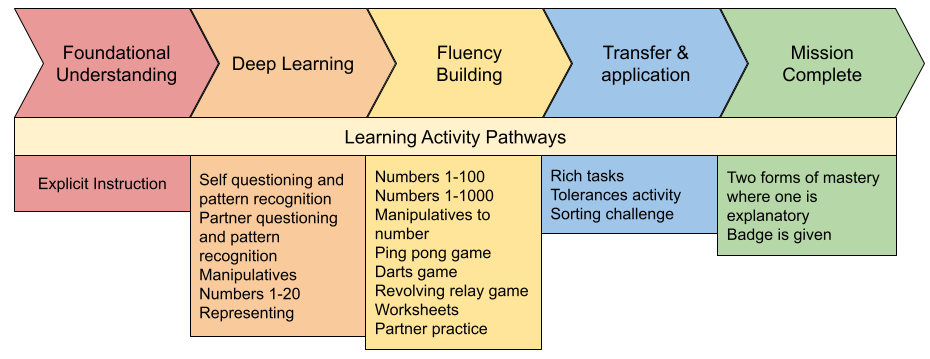
Every mission has rubrics that guide students through the learning journey and set the requirements for mastery. The diagram below shows the pathway activities a student can choose from on a single skill mission — place value:
A challenge mission
One challenge, three ways: Chicken & Human Health.
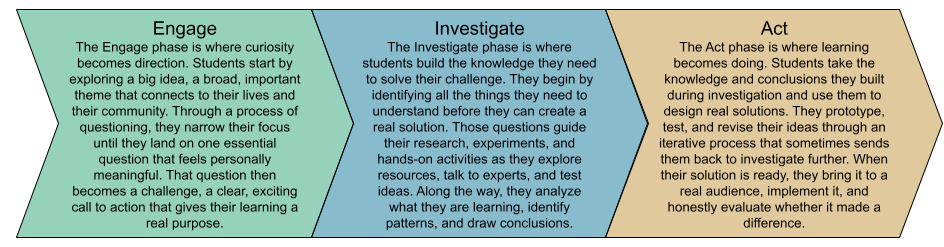
A single challenge runs through the three phases of challenge-based learning — Engage, Investigate, Act — and meets each child at their level. Here’s the same challenge, framed three ways by grade band.
Grades K–2 · Connection
Animals, People & the Earth Are Connected
Challenge: How can we raise animals in healthy and environmentally friendly ways?
The youngest students design and imagine — a chicken coop, a farm layout, a set of animal-care rules — anything that shows they understand what animals need and how to care for them without harming the earth. Their solutions may be drawings, models, stories, or play-based prototypes, but they are real proposals rooted in real understanding.
- Living things have needs, and meeting them keeps them — and us — healthy
- The way we treat animals affects the food we eat
- Caring for animals means caring for the earth too
- Even small choices can help or hurt living things
Grades 3–5 · Cause & Effect
Healthy Animals Mean Safer Food
Challenge: How can we raise animals to protect them from disease and predators and eliminate risks to humans?
Students dig into cause and effect within a biological and agricultural system — how disease spreads, what predators threaten farm animals, how crowding creates risk, and which practices, from sanitation to space to nutrition, break those chains of harm. Solutions might be farm designs, biosecurity protocols, educational tools, or revised care practices.
- Microorganisms and predators are real threats to animals and the people who eat them
- The conditions animals live in determine the risks they carry
- Healthy farming practices protect animals, humans, and communities
- Scientists and farmers use evidence to design better systems
Grades 6–8 · Systems & Power
Systems, Power & the Future of Food
Challenge: How can we reduce the health risks of industrial chicken farming — through policy, innovative techniques, campaigns, or community action?
Middle schoolers step into the role of changemakers — examining who controls the food system, where the risks fall, and what tools can shift outcomes. They investigate antibiotic resistance, environmental impact, economic pressures, and health equity, then design solutions that are realistic, evidence-based, and targeted at a specific lever of change.
- Industrial farming creates health risks that ripple through whole communities
- Antibiotic overuse is accelerating a global public-health crisis
- Change can happen at many levels — individual, community, industry, government
- Equity matters: not everyone bears the same risks from the food system
- Innovative farming models already exist and can be studied, adapted, and scaled
One challenge, every subject
What a single challenge can cover.
The Chicken & Human Health challenge touches every core subject — in real depth. Open any subject to see the standards-aligned topics it can reach.
Mathematics
Number & Operations
- Counting eggs, chicks, and hens
- Tracking daily egg production with tallies and charts
- Adding and subtracting feed quantities and costs
- Multiplying to calculate feed needed per flock size
- Dividing to find averages (eggs per hen per day/week)
- Working with fractions (what fraction of eggs hatched?)
- Calculating percentages (hatch rate, mortality rate, lay rate)
- Using ratios (feed-to-weight gain, space-per-bird requirements)
Measurement
- Measuring and weighing feed portions
- Tracking chick weight over time
- Measuring brooder and coop dimensions
- Calculating area and perimeter for coop and run design
- Measuring temperature in brooder, coop, and incubator
- Measuring water consumption per bird
- Measuring egg dimensions (length, width, weight)
- Calculating volume for feeders and waterers
Data & Statistics
- Recording and organizing data in tables and spreadsheets
- Creating bar graphs, line graphs, and pie charts from collected data
- Calculating mean, median, and mode from egg production data
- Identifying trends in growth, production, and health data
- Comparing data sets (e.g., different feed types, housing conditions)
- Interpreting data to make decisions about flock management
- Conducting simple statistical analysis of hatch rates
Geometry
- Designing coop layout using geometric shapes
- Calculating angles for roof pitch and ventilation
- Understanding scale when creating coop blueprints
- Using coordinate grids to map farm layout
Algebra & Patterns
- Identifying patterns in egg production cycles
- Writing simple equations for feed costs vs. egg revenue
- Modeling growth rates with tables and graphs
- Exploring variables that affect production outcomes
Financial Math
- Calculating startup costs for equipment and supplies
- Tracking ongoing expenses (feed, bedding, veterinary care)
- Calculating cost per egg produced
- Exploring break-even analysis
- Creating a simple budget and profit/loss statement
- Understanding the economics of small-scale vs. industrial farming
Science
Life Science
- Understanding the life cycle of a chicken (egg → chick → pullet → hen)
- Embryonic development stages inside a fertilized egg
- Anatomy and physiology of a chicken (digestive, reproductive, respiratory systems)
- Nutritional needs at each life stage
- Understanding molt and its effect on egg production
- Studying animal behavior (pecking order, dust bathing, foraging)
- Identifying signs of health vs. illness in poultry
- Understanding predator-prey relationships
- Studying genetics (feather color, egg color inheritance)
- Exploring breed diversity and selective breeding history
Microbiology & Disease
- Introduction to bacteria, viruses, and fungi
- How pathogens spread in animal populations
- Common poultry diseases (Marek’s disease, coccidiosis, Newcastle disease)
- The role of biosecurity in preventing disease
- How the immune system responds to pathogens
- Vaccination principles and schedules
- The relationship between crowding, stress, and disease susceptibility
- Understanding zoonotic diseases (diseases transferable to humans)
- How Salmonella and Campylobacter contaminate food chains
- The role of sanitation in breaking disease transmission cycles
Antibiotic Resistance
- What antibiotics are and how they work
- How bacteria develop resistance through natural selection
- The concept of superbugs and why they are dangerous
- The difference between therapeutic and prophylactic antibiotic use
- Alternatives to antibiotics in poultry farming (probiotics, prebiotics, vaccines)
Chemistry & Nutrition
- Macronutrients and micronutrients in chicken feed
- How feed composition affects egg quality and shell strength
- The chemistry of eggshell formation (calcium carbonate)
- pH levels in water and their effect on flock health
- Composting chicken manure — chemical processes involved
- Understanding chemical residues and how they enter the food chain
Physics & Engineering
- Heat transfer principles in brooder design (conduction, convection, radiation)
- Light cycles and their effect on egg production (photoperiodism)
- Ventilation and airflow design in coops
- Structural engineering principles in coop construction
- Simple machines used in farm equipment
- Electrical circuits for lighting and heating systems
- Water pressure and gravity-fed watering systems
Environmental Science
- The nitrogen cycle and how chicken manure fits in
- Composting as a nutrient recycling system
- Land use and carrying capacity concepts
- Watershed and runoff impacts from poultry operations
- Carbon footprint of different farming models
- Biodiversity and the role of free-range systems in supporting it
- Soil health and the relationship between chickens and regenerative agriculture
Earth & Atmospheric Science
- How seasonal changes affect flock management
- Weather impact on coop temperature regulation
- Understanding climate and its role in choosing breeds
Social Studies
History of Chicken Domestication
- Origins of the domesticated chicken from Red Junglefowl in Southeast Asia
- The spread of chickens across trade routes (Silk Road, Polynesian routes)
- How chickens arrived in the Americas — both through European colonization and evidence of pre-Columbian Polynesian contact
- The transformation of chicken farming from backyard flocks to industrial operations in the 20th century
- The post-WWII rise of factory farming and its social and economic drivers
Indigenous Perspectives & Traditional Ecological Knowledge
- How Indigenous peoples across the Americas maintained relationships with animals rooted in reciprocity and respect
- Traditional farming and animal husbandry practices of specific nations (e.g., the Three Sisters and companion planting as a model for integrated systems)
- Indigenous concepts of land stewardship — the idea that humans are caretakers, not owners
- The Haudenosaunee (Iroquois) Great Law of Peace and the concept of thinking seven generations ahead — how does this apply to farming decisions today?
- How colonization disrupted Indigenous food systems and animal relationships
- Contemporary Indigenous-led regenerative agriculture movements and food sovereignty efforts
- Comparing Indigenous animal husbandry ethics with industrial farming practices
- Oral traditions and stories featuring animals as teachers and relatives, not commodities
Food Systems History
- History of the American family farm and its decline
- The role of government policy (subsidies, regulations) in shaping modern food systems
- The Civil Rights movement and food justice — unequal access to healthy food
- The history of the organic and sustainable farming movements
- Key figures in food systems reform (e.g., Wes Jackson, Wendell Berry, Vandana Shiva)
Geography & Culture
- How geography shapes farming practices around the world
- Comparing poultry farming traditions across cultures
- How food traditions connect communities to their agricultural history
- Mapping global hotspots of antibiotic-resistant bacteria linked to intensive farming
Civics & Government
- How food safety laws are made and enforced (FDA, USDA)
- The role of lobbyists and industry in shaping food policy
- How citizens and communities can influence agricultural policy
- Comparing food safety regulations across countries
- The concept of the commons — shared responsibility for shared resources like clean water and air
Economics & Labor
- The economics of small-scale vs. industrial farming
- Labor conditions in industrial poultry processing plants
- Fair trade and ethical sourcing concepts
- The true cost of cheap food — externalized costs to communities and the environment
English Language Arts
Reading Skills & Text Types
- Reading and interpreting scientific studies and articles (informational text)
- Reading and following technical manuals (incubator operation, coop construction)
- Analyzing primary sources (historical accounts of farming practices)
- Reading and evaluating persuasive texts (food policy arguments, advocacy materials)
- Comparing multiple sources on a single topic (e.g., antibiotic resistance)
- Reading charts, graphs, tables, and infographics embedded in texts
- Evaluating source credibility and identifying bias
- Close reading of Indigenous oral histories and traditional ecological knowledge texts
- Reading narrative nonfiction about food systems (e.g., excerpts from relevant books)
- Reading legislation and policy documents at an accessible level
Writing Skills & Text Types
- Keeping a daily observation journal (descriptive and scientific writing)
- Writing lab reports documenting experiments and data collection
- Writing persuasive essays or op-eds on food policy or animal welfare
- Creating informational brochures or guides about chicken care
- Writing a narrative story from the perspective of a chicken in different farming systems
- Designing and writing surveys to gather community data
- Writing grant proposals or funding pitches for farm improvements
- Drafting letters to local officials or food companies advocating for change
- Creating annotated bibliographies from research sources
- Writing reflective essays on what they learned and what they would change
- Developing a farm business plan with written rationale
- Producing a research report synthesizing findings from the investigation phase
Vocabulary & Language Development
- Domain-specific vocabulary across science, math, history, and civics
- Understanding connotation and bias in food industry language (e.g., “free-range,” “natural,” “humanely raised”)
- Analyzing how word choice shapes public perception of farming practices
- Building academic language for presenting findings and defending solutions
Speaking, Listening & Presentation
- Presenting solutions to authentic audiences (community members, farmers, officials)
- Participating in structured debates on food policy and ethics
- Conducting interviews with farmers, veterinarians, and community members
- Collaborating in small groups to design and refine solutions
- Using visual aids, data, and models to support presentations
- Listening critically to opposing viewpoints and responding constructively