Community Well-Being
Community Connection and Wellbeing for School-Age Children
Explore how connection to peers, caring adults, and the natural world supports the wellbeing and growth of elementary and middle school children.
We believe that learning is not something that happens to a child in isolation. It is something that grows in the space between people, and between people and the world around them.
This is not a novel idea. Indigenous peoples have understood it for centuries. Darren Parry, former Chairman of the Northwestern Band of the Shoshone Nation, educator, and author, describes Indigenous education as fundamentally holistic — encompassing not just the intellectual, but the emotional, spiritual, physical, and relational dimensions of a person’s development. Education is viewed as a lifelong journey that nurtures the whole person — body, mind, heart, and spirit. Teachers in Indigenous contexts are not just instructors but guides who support students’ growth in all areas of their lives, helping them to become well-rounded individuals connected to their communities and the world (Parry, 2025). Knowledge, in this framework, is not delivered from a single expert to a passive recipient — it is co-created. It emerges from relationship, reciprocity, and a deep sense of responsibility to others. This is a vision of learning that Western schooling has largely lost and urgently needs to reclaim.
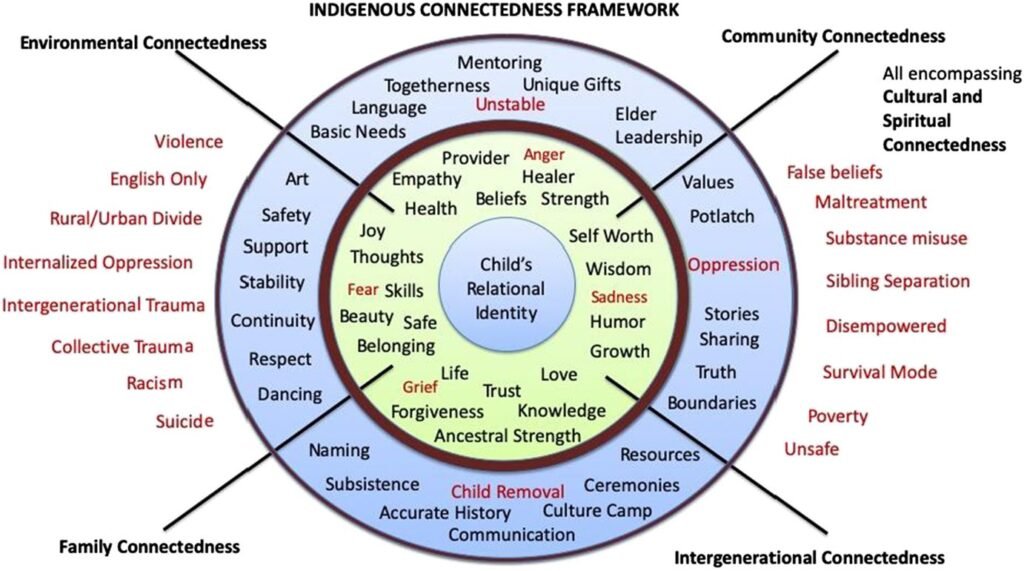
Jessica Saniguq Ullrich’s Indigenous Connectedness Framework gives this vision a research foundation that is both practical and profound. When children are able to engage in environmental, community, family, intergenerational, and spiritual connectedness, this contributes to a synergistic outcome of collective wellbeing. Connectedness is the interrelated welfare of the individual, one’s family, one’s community, and the natural environment (Ullrich, 2019). What Ullrich’s framework makes visible is that child wellbeing is never an individual project. It is a collective one. Environmental connectedness is especially important for children because it acknowledges the source of life, the miracle of creation, and shifts the worldview away from a belief that the environment is an object to extract, exploit or sell Children who are connected — to each other, to caring adults, to the living world around them are children who flourish. The research on school belonging and connectedness confirms this with precision: belonging at school has moderate to strong links with academic motivation, healthy psychological functioning, wellbeing, and social connectedness (Allen et al., 2018). A meta-analysis of interventions found that programs targeting school connectedness produced significant improvements in academic, social, and emotional outcomes — making connectedness not a peripheral concern but a foundational one (Raniti et al., 2025).
Research on nature connectedness deepens this picture. Experiences in natural environments have been demonstrated to engender feelings of belonging, facilitate interpersonal connections, and enhance mutual support within communities. Nature-based activities — especially when collective or community-driven — can serve as inclusive platforms enabling youth from diverse backgrounds to share experiences, develop prosocial values, and strengthen their bonds with peers (Madera et al., 2024). Children who develop a relationship with the natural world carry that relationship into adulthood as both a source of wellbeing and a foundation for genuine environmental stewardship. Nature is not a backdrop to the learning day at Wayfinders. It is a teacher in its own right — one that invites curiosity, humility, and an understanding that we are part of something larger than ourselves.
Community, for all the importance we place on it, does not simply appear. It has to be built — deliberately, through experiences and practices that develop the capacity to be genuinely present with other people. One of the most powerful of these practices is structured dialogue: the ability to bring your own thinking to a conversation, listen deeply to someone else’s, and navigate the friction of genuine disagreement with skill and respect. As students consider different — and often conflicting — ideas in a Socratic seminar, they make meaning by thinking deeply and critically about concepts, looking at ethical quandaries, and developing moral principles. They refine their critical thinking skills and deepen their collective understanding, engaging in a variety of thought-demanding ways to explain, muster evidence, generalize, apply concepts, and analogize (Tredway, 1995). Students who can effectively participate in deliberative discussions develop essential civic skills like empathy, tolerance, a desire to understand diverse perspectives, and a willingness to engage with people with different beliefs — all of which contribute to a democratic culture where diverse voices are encouraged, heard, and respected. The Socratic seminar teaches students not just how to think, but how to think together — which is a skill the world needs as much as any academic content.
The research on powerful learning environments makes the relational dimension of schooling equally concrete. Placklé and colleagues (2014) found that powerful learning environments are characterized by authentic and challenging tasks, training methods that encourage students’ active participation through collaborative learning and problem-based approaches, differentiated support, and guidance that focuses on the student’s professional and personal development. What students consistently tell researchers they want — and what they need in order to genuinely engage — is not only intellectual challenge. It is to be known, to be heard, and to belong to something that matters. When students are being heard and validated, reflectiveness on experiences and meaning-making is stimulated. Through safe dialogue and deep reflection, learners can construct the kind of understanding that persists and travels with them (Kuijpers & Meijers, 2011).
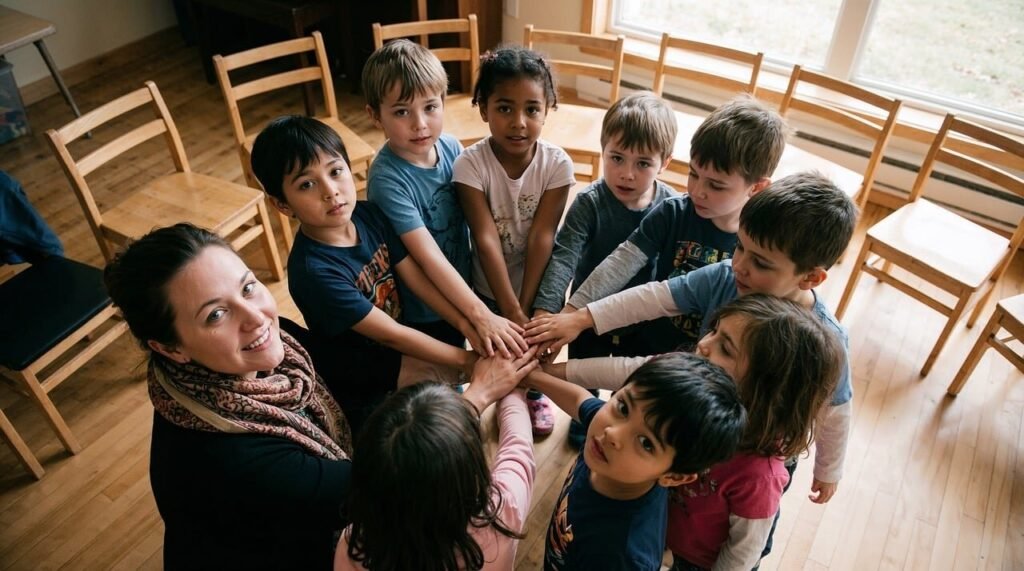
At Wayfinders Academy, community is not a value we list on the wall. It is the medium in which learning happens. Every mission, every discussion, every moment of leadership and service is designed to deepen the connections between learners, to the adults who guide them, to the natural world they share, and to the communities beyond campus that they are already part of and will one day help to lead. We believe, as the Indigenous wisdom traditions and the modern research both confirm, that a child who is connected is a child who is ready to learn — and that a community of connected learners is capable of things no individual student could ever accomplish alone.
References
Allen, K.-A., Kern, M. L., Vella-Brodrick, D., Hattie, J., & Waters, L. (2018). What schools need to know about fostering school belonging: A meta-analysis. Educational Psychology Review, 30(1), 1–34.
Kuijpers, M. A. C. T., Meijers, F., & Gundy, C. (2011). The relationship between learning environment and career competencies of students in vocational education. Journal of Vocational Behavior, 78(1), 21-30.
Madera, F., Olcese, M., & Migliorini, L. (2024). A systematic review of nature connectedness in adolescents and young adults: Fostering environmental responsibility and sustainable practices. Journal of Prevention & Intervention in the Community, 52(3-4), 400-434.
Parry, D. (2025). The path forward: Transforming education with Indigenous wisdom. Journal of Educational Impact, 2(2).
Placklé, I., Könings, K. D., Jacquet, W., Struyven, K., Libotton, A., van Merriënboer, J. J. G., & Engels, N. (2014). Students’ preferred characteristics of learning environments in vocational secondary education. International Journal for Research in Vocational Education and Training, 1(2), 107–124.
Raniti, M., Jorm, A. F., Thorn, A., & Allen, K.-A. (2025). Interventions to improve connectedness, belonging, and engagement in secondary schools: A systematic review and meta-analysis. Education Sciences, 15(5), 582.
Tredway, L. (1995). Socratic seminars: Engaging students in intellectual discourse. Educational Leadership, 53(1), 26–29.
Ullrich, J. S. (2019). For the love of our children: An Indigenous connectedness framework. AlterNative: An International Journal of Indigenous Peoples, 15(2), 121–130.